
Modern artificial intelligence architecture spans multiple abstraction layers—from core neural network topologies to enterprise-level application patterns.
1. Foundational Model Topologies
- Dense Transformers: The baseline architecture utilizing multi-head self-attention mechanisms. While highly expressive, they suffer from quadratic computational complexity relative to context length.
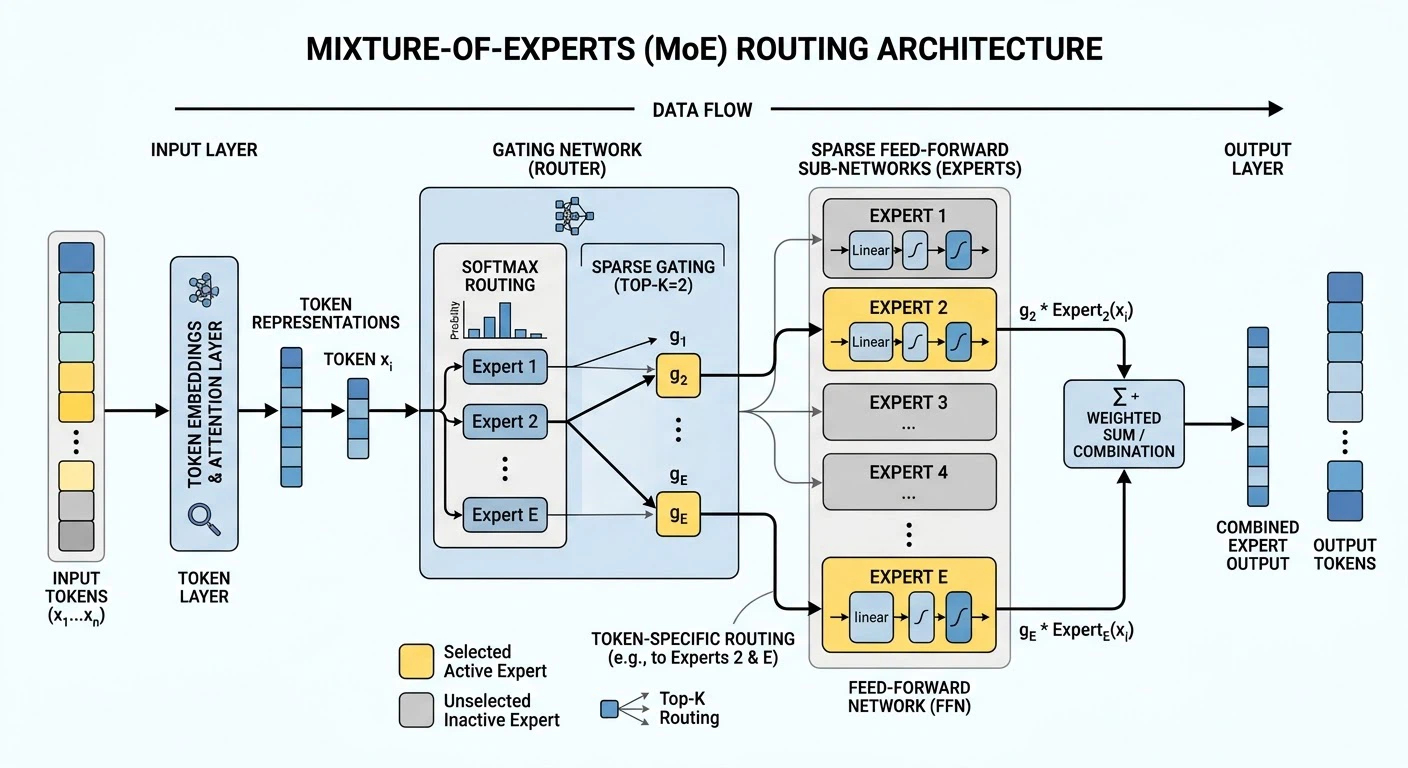
- Mixture of Experts (MoE): Routes incoming tokens through a gating network to a sparse subset of feed-forward sub-networks (“experts”). This allows massive total parameter counts while maintaining low active compute costs per token.
- State Space Models (SSMs) & Hybrids: Architectures like Mamba and hybrid designs (e.g., Jamba combining Transformers, SSMs, and MoE) replace or supplement traditional attention with linear recurrence, enabling efficient processing of ultra-long contexts with minimal KV-cache footprints.
2. Modality & Functional Engines
- Vision-Language Models (VLMs): Native multimodal architectures that project visual patches and text tokens into a shared latent space for joint reasoning.
- Embedding & Masked Models: Specialized lightweight encoders (e.g., BERT-derived or bi-encoders) optimized for semantic vector generation, document classification, and high-speed vector database retrieval.
- Large Action Models (LAMs): Architectures explicitly trained or scaffolded to execute multi-step workflows, API calls, and browser interactions.
3. Application & Systems Engineering Patterns
- Advanced RAG (Retrieval-Augmented Generation): Modular pipelines incorporating hybrid search (dense vector + lexical BM25), cross-encoder reranking, and deterministic structured extraction (e.g., Pydantic schema validation) to ground outputs in trusted data sources.
- Agentic Frameworks: Orchestration layers utilizing canonical patterns like ReAct (Reason + Act), Plan-Execute, and reflection loops to handle complex, open-ended tasks.
- Protocol & Tool Standardization: Standardized communication layers like the Model Context Protocol (MCP) that decouple LLMs from backend tools, databases, and enterprise systems via secure, schema-defined endpoints.
4. Deployment & Infrastructure Architecture
- Inference Optimization: Hardware-aware acceleration techniques including FlashAttention, KV-cache quantization (e.g., AWQ, GGUF), and speculative decoding to maximize throughput and lower latency.
- Data Sovereignty & Local Orchestration: Enterprise patterns deploying open-weight models locally (via runtimes like Ollama or llama.cpp) to guarantee data privacy, air-gapped security, and strict regulatory compliance (such as DSGVO).
For a brief breakdown of how modern components like agents, MCP, and RAG fit into current production systems, check out this overview of State of AI Architecture in 2026.
This video provides a quick visual summary of how modern agentic workflows, RAG, and tool protocols interact in practice.